Parkinson’s disease (PD) is a progressive illness of the nervous system that affects movement, balance, and coordination. Medications such as Levodopa and dopamine agonists are typically the first line of treatment but tend to become less effective as time goes by. For patients who have challenges with side effects from medications or seeking better control of their symptoms unpredictably, Deep Brain Stimulation (DBS) could be life changing.
In this blog, we will discuss how DBS works, who might benefit from it, and how it is changing the management of Parkinson’s disease by taking management to another level, beyond medication.
Understanding Parkinson’s Disease
Parkinson’s disease is the result of nerve cells in the brain, more specifically in the substantia nigra, being unable to produce adequate dopamine – a neurotransmitter that is responsible for controlling smooth and coordinated muscle movements. Lack of dopamine leads to the most common symptoms of Parkinson’s disease including:
- Tremors (shifting, most often in hands or fingers)
- Muscle stiffness/rigidity
- Slowness of movement (bradykinesia)
- Problems with balance or posture
- Changes in speech or facial expressions
While medications work to replenish or mimic dopamine, as the disease progresses, the brain has an inconsistent response resulting in fluctuation, or periods of time where symptoms are controlled (on-time) and periods of time where symptoms return (off-time).
The Limitations of Medication
In the initial course of Parkinson’s disease, new medications can have a substantial impact on improving symptoms. However, with time and sustained use, there are some challenges that occur, such as:
- Wearing-off effect: With time, the length of time to get relief from symptoms typically becomes shortened between doses.
- Dyskinesias: Involuntary movements related to the effect of excess dopamine.
- Unpredictable response: Symptoms may be variable or unpredictable, which affects the quality of life.
At this point, many patients and their neurologists seek further intervention with advanced therapy. An example of an advanced therapy is Deep Brain Stimulation.
What is Deep Brain Stimulation (DBS)?
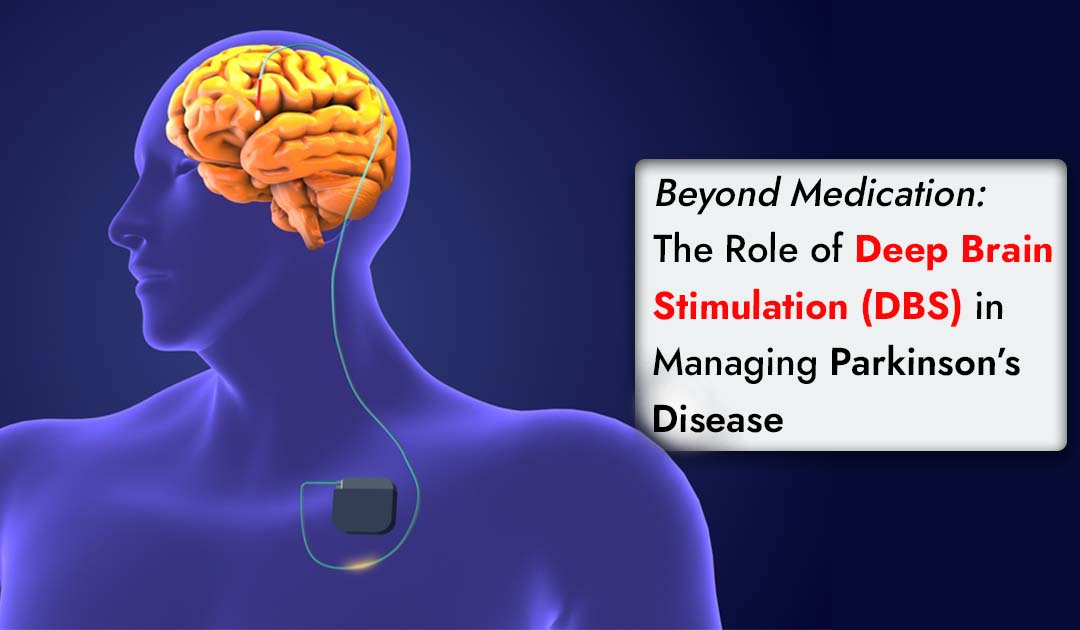
Deep Brain Stimulation is a surgical therapy that involves delivering mild electrical pulses to modify abnormal brain activity that is responsible for Parkinson’s symptoms. DBS does not destroy any brain tissue and does not cure Parkinson’s disease. It modulates the electrical signals in particular areas within the brain, to restore more efficient motor control.
The procedure has three components:
- Electrodes: Thin wires, implanted in targeted brain areas typically the Subthalamic Nucleus or Globus Pallidus Internus.
- Implanted Pulse Generator (IPG): A small device, similar to a pacemaker, implanted under the skin at the chest or abdomen.
- Connecting wires: Connect the electrodes in the brain to the pulse generator.
The IPG delivers continuous, controlled electrical pulses to the brain, designed to help manage symptoms such as tremor, rigidity, and slowness.
The Functionality of DBS
The brain is functional through intricate electrical circuits. In cases of Parkinson’s, these circuits have become overactive and uncoordinated due to a loss of dopamine. The goal of DBS is to restore an optimal level of communication among neural pathways.
While medications that are taken orally are working chemically, DBS works electrically and allows for precise levels of therapy to be delivered. The stimulation can be altered over time with regard to frequencies, amplitudes, and locations to address the changing needs of the individual.
Who is Eligible for DBS?
Not every person living with Parkinson’s will be a candidate for a Deep Brain Stimulator. The following are characteristics that the optimal candidate will exhibit:
- Patients who have lived with Parkinson’s for four (4) or more years.
- Patients who respond to Levodopa and have motor fluctuation or develop dyskinesias.
- Patients who do not have significant cognitive decline or spiral psychiatric decline.
- Patients whose symptoms are preventing them from meaningfully engaging in activities of daily life despite optimal medications.
A multidisciplinary team which consists of a neurologist, neurosurgeon, and psychologist, will typically evaluate to ultimately determine the individual is eligible through a series of formal assessments and possible imaging of the brain.
Potential Benefits of Deep Brain Stimulation
DBS has provided incredible benefits to many people living with Parkinson’s disease in terms of their quality of life. The following are potential benefits:
- Better Control of Movement: Very significant decrease in tremors, rigidity, and bradykinesias.
- Reduced Dependence on Medication: Many people are able to decrease their medications as much as 30-50%, and have the added benefit of reducing side effects.
- Enhanced Daily Living: Patients can frequently return to independent function with abilities such as walking, writing, or speaking.
- Adjustable and Reversible: DBS can be altered and adjusted non-invasively, and the procedure is also reversible.
- Stable Long-Term Outcomes: Research indicates that many patients have maintained sustained benefit for as long as 10 years after surgical performance.
Risks and Considerations
As with any surgical procedure, DBS carries complications like infection, bleeding, or hardware malfunction. There also may be some risk of mood disturbances or difficulty with speech, both of which are often manageable with programming or adjustments.
Most importantly, DBS is not a cure. It may help control symptoms but doesn’t reverse disease progression. Therefore, ongoing care with a neurologist, modifications in lifestyle and health, as well as physiotherapy remain essential components of management.
Life After DBS: A New Beginning
When patients undergo DBS, they often will note a new sense of freedom. Many simple pleasures, such as drinking a cup of coffee without tremors, or walking without stiffness, once again become possible.
After surgery, there will be a programming phase where the neurologist attempts to customize/adjust the device settings for maximum outcomes. Regular follow-ups help ensure long-term management of motor control is stable and functioning at its best.
In addition to the device, patients should also focus on maintaining a healthy lifestyle, doing regular aerobic exercise, sleeping well, and managing stress in order to help optimize their overall quality of life.
The Future of Treatment for Parkinson’s Disease
The technology surrounding DBS continues to innovate. New devices have directional leads for more targeted stimulation and rechargeable batteries that last even longer. Research is also underway on the concept of closed-loop DBS, a more intelligent form of DBS that would modify stimulation levels based on real-time brain activity.
Conclusion
DBS represents an extraordinary advancement in the treatment of Parkinson’s disease, providing patients with new hope. Patients with Parkinson’s often live with limitations related to their symptoms or the side effects from medication while attempting to manage their condition.
DBS provides patients with the ability to take charge of their body once again. While this is not a cure, it is a significant step forward for patients and demonstrates that innovation combined with expert, neurological care can truly transform lives.