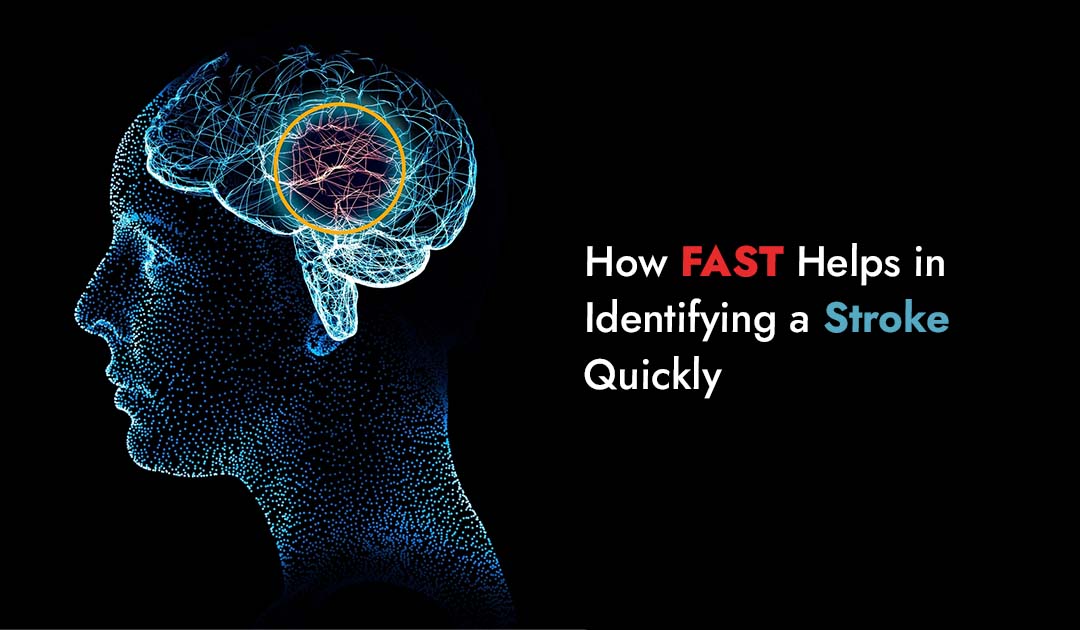
The warning signs of a stroke show up unannounced. That is why knowing the FAST technique can help you save someone’s life.
Learning the FAST technique is not difficult and is extremely easy to perform as well. It is an important and effective indicator of stroke in early stages. These factors allow us to recognize the signs and act on them. Let us now learn what FAST stands for and how we may use it:
F is for Face
The first thing you need to look for is a change in the face. Is the individual smiling? Is the face sagging or uneven on one side? Is the individual’s smile uneven, or is he/she unable to move half of his/her mouth? Sagging of the face is a common warning sign of stroke and is usually the result of weakness or paralysis of half of the facial muscles. This is because a stroke may affect blood flow to the brain’s control of the facial muscles, usually on the side of the brain where the damage is most severe. If you observe this, it is a warning sign that something is seriously wrong.
A is for Arms
The second thing is to examine the arms. Have them hold both arms straight out in front of them with palms facing up. Stand next to them and take a look; is one arm lower, or is one arm much weaker than the other? In very bad cases, the person can’t lift either arm. Weakness or numbness of the arms is another very common symptom of a stroke, where the area of the brain that is in charge of movement and sensation is harmed. Even the slightest issue in the strength or movement of the arms is a red flag.
S for Speech
Speech is the third to observe. Request the individual to repeat a brief sentence, like “The sky is blue” or “It’s a sunny day.” Listen carefully to see if the individual’s speech is slurred, mumbled, or difficult to understand. Is the individual having trouble with words coming out, or are words that the individual is saying not relevant to what he or she is attempting to say? Trouble with speaking or comprehending words is a stroke warning sign, as it indicates that the language abilities of the brain are impaired. Occasionally the individual appears to be confused or will not respond to anything. Any abrupt change in speech, even slight, must be taken as a red flag.
T is for Time
The third and most important one is time. If you notice any of these signs, such as a drooping face, weakness on one side of the body, or slurred speech, call the emergency services right away. Do not try to drive the person yourself to the hospital, and don’t wait and watch to see if the symptoms cease. Stroke medications are most effective if they are provided immediately after the symptoms begin, typically within a few hours. Make sure you write down the time symptoms began, which will help doctors make the decision on the treatment. Time is of the essence in a stroke.
Why Is the FAST Test Important?
The FAST test works so well because it is easy to learn and apply. FAST won’t detect every stroke, sudden blindness, dizziness, or loss of balance, but it will detect the most common and obvious warning signs. Anyone of any age and at any time can have a stroke. But with the FAST test, you have a great tool at your disposal to recognize the signs and act quickly.
If you ever observe someone with an unexpected drooping face, weakness of an arm, or slurred speech, don’t hesitate and call emergency services immediately, and note the time symptoms first appear.
Learn more about stroke and the FAST technique by visiting a healthcare provider immediately.